

Summary
- Once that principle is understood, a designer can borrow something from Giger without reproducing his most recognizable surfaces.
- Its dark surfaces and mechanical anatomy allow it to merge visually with corridors and equipment, which turns Giger’s design language into a practical component of suspense.
- Giger supplied Alien with a coherent visual environment whose internal rules can be sensed long before they can be described, and much of its subsequent influence came from designers continuing to work inside questions that his images had left open.
AI Generated Summary
“I had never been so sure of anything in my life.”
— Ridley Scott, recalling his reaction to H. R. Giger’s work
The most disturbing quality of the Alien appears before the creature has done very much. It seems native to a world that existed before the characters entered it, governed by rules that nobody on screen understands. Science-fiction cinema already had a substantial inventory of extraterrestrials by 1979, along with decades of speculative machines and unfamiliar planets. However strange their appearance, most remained readable according to ordinary categories. Organisms belonged to biology. Equipment had been engineered for a purpose. Architecture contained the action. H. R. Giger’s work complicated those distinctions so thoroughly that identifying the function of a form often became difficult. Bone-like structures carried loads. Tubes suggested plumbing while retaining the appearance of internal organs. Mechanical components disappeared into surfaces with the tension and vulnerability of skin.
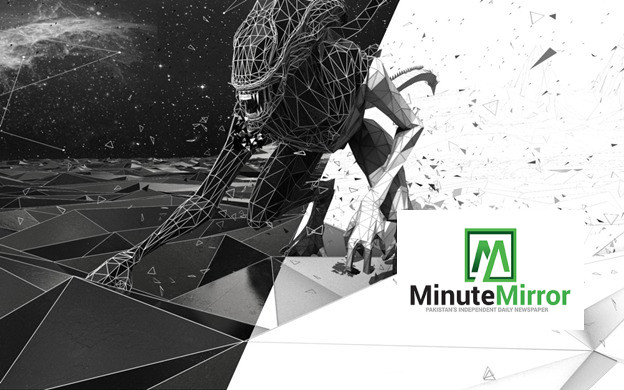
The xenomorph belongs to this environment so completely that isolating it as a creature design misses part of what made it effective. Its body follows the same visual logic as the derelict spacecraft and the strange apparatus surrounding the Space Jockey. The audience encounters a family of related forms before it has enough information to classify them. Giger had already developed this language in his independent work. Alien gave it scale, movement and an enormous audience. The film did not require him to invent a visual vocabulary from nothing; it provided a place where an existing one could operate across bodies and spaces simultaneously.
Giger called that language biomechanics. The word is useful because it identifies the persistent fusion of anatomy with mechanical construction, although looking at the images reveals something less orderly than the term might suggest. Machinery does not sit cleanly beside flesh. A vertebral structure may perform the visual role of a mechanical support, while cabling carries the tension of tendons or exposed nerves. Reproductive anatomy enters objects whose practical function remains obscure. Surfaces can look manufactured from a distance and disturbingly organic at closer range.
This consistency explains why superficial imitations of Giger are usually recognizable as imitations. The visible inventory is easy to copy. An artist can assemble ribs, tubes, polished darkness and elongated skeletal shapes and arrive at something vaguely Gigeresque. The difficulty lies in making those elements appear to share an internal necessity. In Giger’s strongest images, anatomy seems to determine construction. A spinal form does not have to be ornamental if the surrounding object appears to require it structurally. The same principle can extend across an entire room. Once enough components obey that logic, the viewer stops seeing a machine decorated with anatomical references and starts confronting an object whose engineering cannot be separated from its physiology.
The xenomorph’s head compresses much of this uncertainty into a form that remains immediately recognizable. Its length and smooth enclosure permit several associations, including armor and animal anatomy, without providing a stable explanation of what the skull actually is. Sexual associations are difficult to avoid, though they do not exhaust the design. More consequential is the absence of visible eyes. Human faces provide information continuously through gaze. We estimate attention and intention from small movements around the eyes, often before a body moves. The Alien clearly perceives its surroundings, yet its face denies the viewer access to that familiar exchange.
Its inner jaw introduces another layer of mechanical behavior. The movement is abrupt and functional, with the directness of a driven component. Little expression is required beforehand. Many screen predators communicate aggression through changes in posture or facial tension that remain legible to human observers. The xenomorph can attack without supplying those signals. Its body performs a function. That relative absence of readable emotion gives the violence an impersonal quality without requiring the creature to behave like a literal machine.
The reproductive cycle places the same design logic inside the human body. A facehugger does not simply injure its victim from outside. It attaches itself closely enough to turn physical intimacy into a source of anxiety. Its limbs enclose the head and its tail secures the contact at the throat. What follows occurs largely beyond sight. An organism is introduced into the host and develops internally while the victim temporarily returns to apparent normality.







Comments
0 commentsNo comments yet — be the first.