

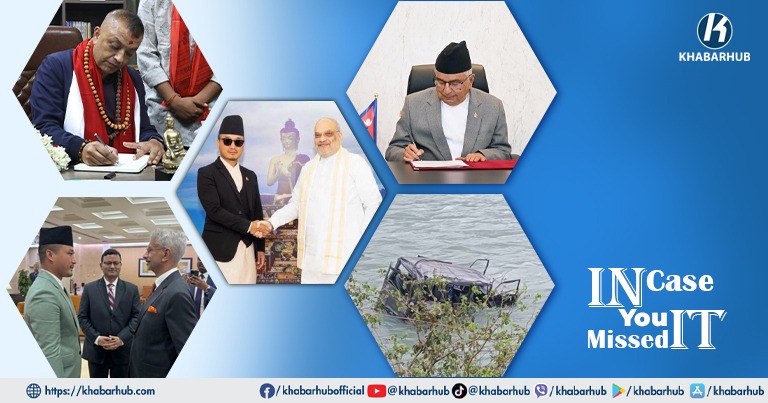
KATHMANDU: Nepal’s political developments over the past week highlighted a central challenge facing the country: translating promises of good governance, political renewal and public accountability into tangible results. From Prime Minister Balendra Shah’s appeal for solidarity with disaster-hit families to the Nepali Congress’s leadership reshuffle, an internal investigation within the ruling Rastriya Swatantra Party (RSP), and renewed diplomatic engagement with India, the week offered a snapshot of a political system under pressure to demonstrate that change can deliver more than rhetoric.
The developments also exposed the competing demands confronting the government and political parties. Citizens expect effective disaster recovery, economic opportunities and cleaner public institutions, while parties face growing pressure to demonstrate internal democracy, represent diverse communities and ensure that allegations of misconduct are addressed transparently. Meanwhile, Nepal’s relationship with India remains central to its security, economic connectivity and disaster preparedness.
Taken together, these events suggest that Nepal’s political credibility will depend less on announcements and more on institutional performance, measurable outcomes and the consistency with which leaders apply their stated principles.
Disaster solidarity must lead to sustained recovery
Prime Minister Shah’s Dashain message came amid grief following deadly incidents in Rasuwa, Nuwakot and Gorkha. His condolences to bereaved families, concern for the injured and pledge to prioritise the rehabilitation of displaced people placed disaster recovery at the centre of the government’s public commitments.
The government’s commitment to good governance will be measured by whether accountability mechanisms function impartially and produce legally sustainable outcomes.
The message was significant because major festivals often expose the social and economic inequalities that persist beneath national celebrations. While Dashain traditionally brings families together, disaster-hit households may face destroyed homes, lost livelihoods and uncertain futures. For displaced people, the immediate priority is not the symbolism of a festival but access to shelter, food, healthcare, education and a realistic path towards rebuilding their lives.
The government must therefore ensure that expressions of solidarity translate into practical support. This requires transparent beneficiary identification, timely compensation, adequate temporary housing and reconstruction plans that account for future disaster risks. Coordination among federal, provincial and local authorities is equally important, particularly where damaged roads, bridges and public infrastructure restrict access to affected communities.
There is also a broader governance lesson. Disaster response is a test of state capacity. Delays, duplication and unclear responsibility can undermine public trust even when political leaders express genuine concern.
Shah’s emphasis on rehabilitation and good governance will carry weight only if affected families can see improvements in their daily lives. The coming weeks should be judged by the speed and fairness of relief distribution, the restoration of essential services and the government’s ability to prevent vulnerable communities from being left behind.
Economic opportunity remains the foundation of political credibility
The prime minister’s acknowledgement that many Nepalis are compelled to seek employment abroad because of limited opportunities at home touched on one of Nepal’s most persistent structural problems. Migration has become a source of household income and national foreign exchange, but it also separates families and leaves the domestic economy dependent on opportunities created elsewhere.
Shah’s assertion that Dashain should not become an economic burden for anyone framed prosperity as a social objective rather than simply a matter of economic growth. Yet the challenge is to turn this principle into policy.
Expanding productive employment requires a more reliable environment for private investment, better access to finance, skills development and stronger links between education and the labour market. Agriculture, tourism, hydropower, manufacturing and information technology offer potential avenues for employment, but they need predictable policies and effective implementation.
Good governance is central to this effort. Businesses are less likely to invest when administrative procedures are cumbersome, regulations unpredictable or public procurement vulnerable to political influence. Likewise, young people are less likely to remain in Nepal if they see limited opportunities for professional advancement.
The government’s credibility will therefore depend on whether it can improve the conditions that drive migration, rather than treating overseas employment solely as a problem of family separation. The prime minister’s festival message established a political aspiration; delivering on it requires sustained economic reform and demonstrable results.
Nepali Congress leadership change creates an opportunity for renewal
The election of Gagan Thapa as president of the Nepali Congress, alongside a new team of 18 other office bearers, marked another important development in the country’s party politics. Thapa’s decisive victory over Shyam Krishna Khadki, with 6,584 votes against 375, gives the new leadership a strong mandate within the convention process described in the report.
The outcome offers the party an opportunity to address concerns about organisational renewal, public confidence and its political relevance. A new leadership team can bring fresh energy to policy development, internal organisation and engagement with younger voters. However, leadership change alone does not guarantee institutional transformation.
The composition of the new team also deserves attention. The election of office bearers representing women, Indigenous nationalities, Dalit, Madhesi, Tharu, Muslim and other communities indicates an effort to incorporate Nepal’s social diversity into party leadership. Such representation can strengthen a party’s understanding of different communities’ concerns and broaden participation in decision-making.





Comments
0 commentsNo comments yet — be the first.