

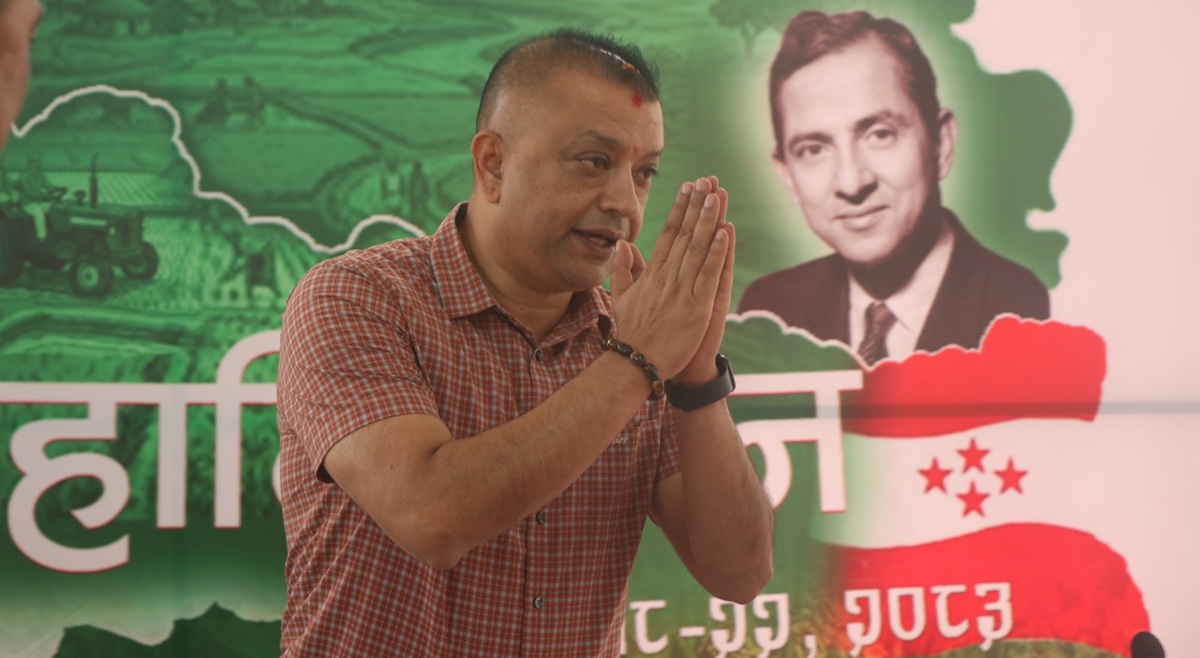
NC President Thapa outlines 29 proposals at Central Working Committee meeting
KATHMANDU: Nepali Congress (NC) President Gagan Kumar Thapa has presented a political report at the party’s Central Working Committee meeting, outlining the political, ideological, organizational and economic direction the party should take over the next four years.
The report, which is to be presented at the 15th General Convention, covers a wide range of issues, including a review of the party’s past performance, the government’s role and accountability, a policy of not forming pre-election alliances, party restructuring, cooperation with the private sector, greater youth participation and the vision of a “Prosperous Nepal, Respected Nepalis.”
Thapa’s report acknowledges that the Nepali Congress has prioritized positions and power over its core objectives over the past two decades. It states that the politics of alliance-building, division, factionalism and political transactions has weakened the party’s moral foundation. The report also says the tendency to protect people aligned with the party in cases of corruption and irregularities has undermined the autonomy of public institutions.
The report further states that the Congress has become increasingly disconnected from the younger generation and has failed to adequately understand changing public expectations. It proposes reforming the party through the second special general convention and seeking forgiveness from the people for its shortcomings.
The report primarily covers 29 issues, including:
Historical contribution and self-evaluation of the Nepali Congress
The report recognizes the Congress’s historical contributions to the political movements of 2007 BS, 2046 BS and 2062–63 BS, as well as the constitution-making process.
However, it concludes that the party has focused more on positions and power than its core objectives over the past two decades. It says alliance politics, internal divisions, factionalism and political transactions have weakened the moral foundation of the Congress.
The report also states that the tendency to protect party-aligned individuals involved in corruption and irregularities has weakened the autonomy of public institutions and contributed to the party’s growing distance from the younger generation.
The August 8-9, 2025 public uprising and the Nepali Congress’ defeat
The report states that the public uprising of August 8-9, 2025 should not be dismissed as a conspiracy. It recognizes demands for good governance, opportunities and fairness as legitimate expressions of public dissatisfaction.
At the same time, it argues that new political forces should not claim exclusive ownership of the movement. The report proposes an impartial investigation into the use of force, violence, loss of life and property, and alleged state repression during the uprising. It calls for those responsible to be brought to justice and for victims to receive truth, justice and reparations.
The Congress’s defeat in the last election on March 5 has been reviewed as the result of growing distance from citizens and political weaknesses accumulated over the past two decades. Accepting the electoral mandate, the party has expressed its commitment to play the responsible role of the main opposition.
A new role for the opposition
The report proposes that the Congress, with 38 seats, effectively monitor the government in Parliament. It calls for the party to scrutinize government activities on the basis of evidence and facts, speak out against corruption, rights violations and misgovernance, and present alternative policies and national priorities rather than merely criticizing the government.
It also proposes the practice of a “shadow government” to monitor ministries at both the federal and provincial levels, while giving priority to long-term national issues over day-to-day political disputes.
New policy on elections and alliances
Thapa has proposed that the Congress should not form an electoral alliance with any party before the upcoming elections. Instead, the party would seek votes under its own symbol, field its own candidates and go to the people with its own agenda.
The report proposes giving greater weight to competence, contribution and performance than to factional affiliation, access and patronage in candidate selection.
It also calls for greater use of primary elections, public opinion polls and direct voting by party members in selecting candidates. The report proposes that membership rules should not be changed at the last minute to influence the general convention or candidacy.
Ideological renewal of the Nepali Congress
The report proposes renewing the party’s ideology in line with the needs of the 21st century and changing socio-economic conditions, while retaining nationalism, democracy and democratic socialism as its core ideological foundations.
It proposes defining nationalism not merely in terms of geography and slogans, but also through national capacity in energy, food, technology and finance. Similarly, democracy should be linked not only to elections but also to citizens’ participation in decision-making and the exercise of public power.
The report proposes linking BP Koirala’s socialist vision with the modern social market economy and incorporating Pradeep Giri’s studies, debates, self-criticism and advocacy for excluded communities into the party’s ideological tradition.
“Prosperous Nepal, Respected Nepalis”
The report states that economic growth alone should not be considered the sole measure of progress. It proposes making education, health, nutrition, skills, capabilities and citizens’ substantive freedoms the foundations of development.
It also proposes making the development of citizens’ capabilities, access to opportunities and co-creation the principal approaches to national progress.
According to the report, development should not be driven by the government alone, but through collaboration among citizens, communities, the private sector, cooperatives, universities and experts. It also calls for greater clarity regarding the outcomes and responsibilities associated with major state decisions.
Five-question accountability system
The report proposes a five-question accountability system for every major government and public decision:
What decision was made?
Why was it made?
Who is responsible?
What results were achieved?
If the expected results were not achieved, what improvements were made?
It proposes making these five questions the basis of public accountability.
Open-source citizen dashboard
The report proposes developing a digital system through which citizens can directly access information on development projects, budget expenditures and responsible officials.
It calls for real-time monitoring and citizen oversight of government activities by publicly disclosing the status of projects, the amount of money spent and the officials responsible for implementation.





Comments
0 commentsNo comments yet — be the first.