

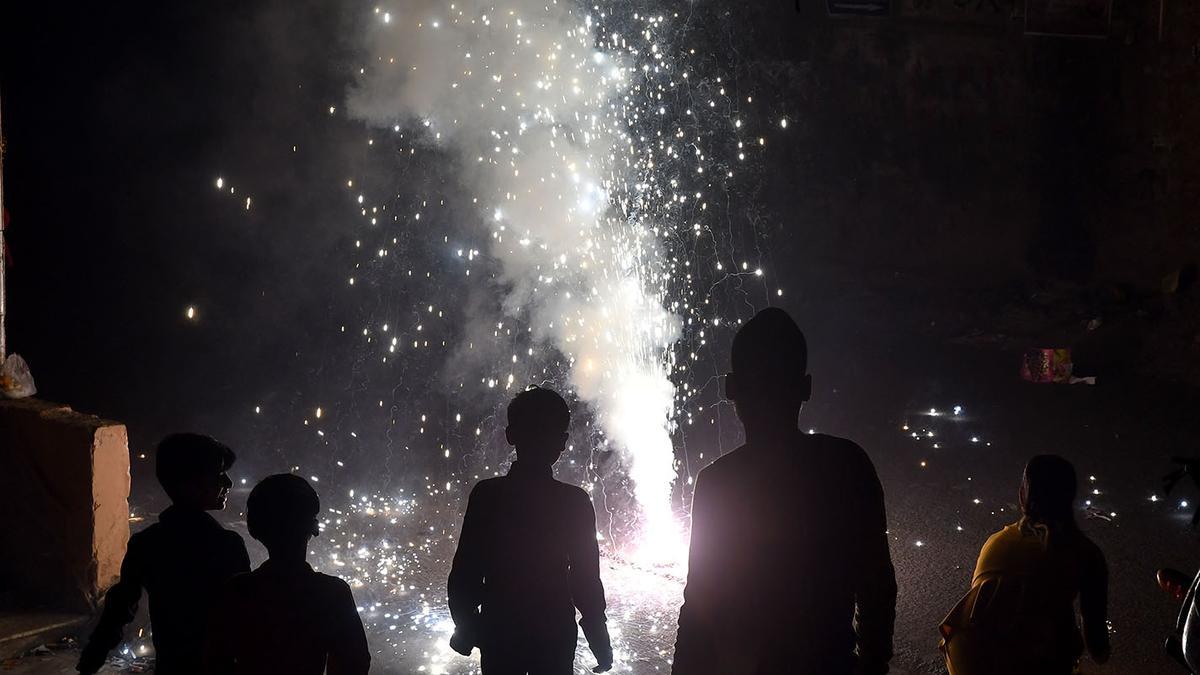

In 2024, IMD warned that firecrackers and stubble fires could push Delhi’s air into the “severe” category when dispersion conditions are unfavourable. Representative file image. | Photo Credit: The Hindu
Story so far: On September 30, the Supreme Court ruled out a nationwide firecracker ban and accepted CSIR-NEERI’s recommendation for a “limited and conditional relaxation”. This allows the manufacture of next-generation joined green crackers that meet noise, emission and safety norms ahead of Diwali. The Bench said it would not permit 24-hour bursting and would consider fixed time windows.
What are ‘green’ crackers?
They are crackers whose chemistry has been reworked to release less particulate matter than conventional ones, without losing brightness, sound or shelf life. NEERI’s (CSIR-National Environmental Engineering Research Institute) changes include additives such as zeolite, water-releasing compounds that act as dust suppressants, and metallic composites that improve combustion. Conventional crackers rely on barium nitrate, antimony and other metals linked to respiratory disease.
The label is a misnomer, as there is nothing environmentally friendly about these crackers. NEERI’s own scientists have called them “reduced emission fireworks”. NEERI claims that the earlier generation of ‘green crackers’ saw a 30% cut in particulate matter. Its newer analysis says that the newer variants, called ‘Gen-2’, reduce pollution 45%-60% for PM10 and PM2.5, using formulations with less barium. However, these are laboratory figures, not verified in real-world conditions. Only manufacturers with a licence from the Petroleum and Explosives Safety Organisation (PESO), the central explosives regulator, can register with NEERI.



Comments
0 commentsNo comments yet — be the first.