


KATHMANDU: Nepal News presents today’s snapshot of Nepal’s economic activities. Get quick updates on major market movements, policy shifts, and financial developments shaping the economy of Nepal. Here are the key economic highlights for today:
Govt Introduces New Bills to Split CAAN into Oversight and Service Authorities
In a major overhaul aimed at resolving decades-long safety concerns, the government has introduced legislation to unbundle the Civil Aviation Authority of Nepal (CAAN), ending its dual status as both service provider and industry regulator. Minister for Culture, Tourism and Civil Aviation Khadak Raj Poudel (Ganess) registered the Civil Aviation Authority Bill 2026 and the Nepal Air Service Authority Bill 2026 at the House of Representatives. Once enacted, the legislation will establish two independent bodies: a standalone Civil Aviation Authority dedicated strictly to safety oversight and licensing, and a separate Air Service Authority tasked with airport operations, infrastructure growth, and air navigation management. The law governing the operational entity will take effect 91 days after receiving presidential assent. The structural split directly addresses long-standing critiques from international aviation bodies. Audits conducted by the International Civil Aviation Organization (ICAO) in 2009, 2013, 2017, and 2022 repeatedly flagged CAAN’s overlapping mandate as a serious conflict of interest. The issue also contributed to the European Union placing Nepali carriers on its air safety blacklist.
Finance Minister Heads To US For Talks On Aid, Reconstruction And Economic Reform
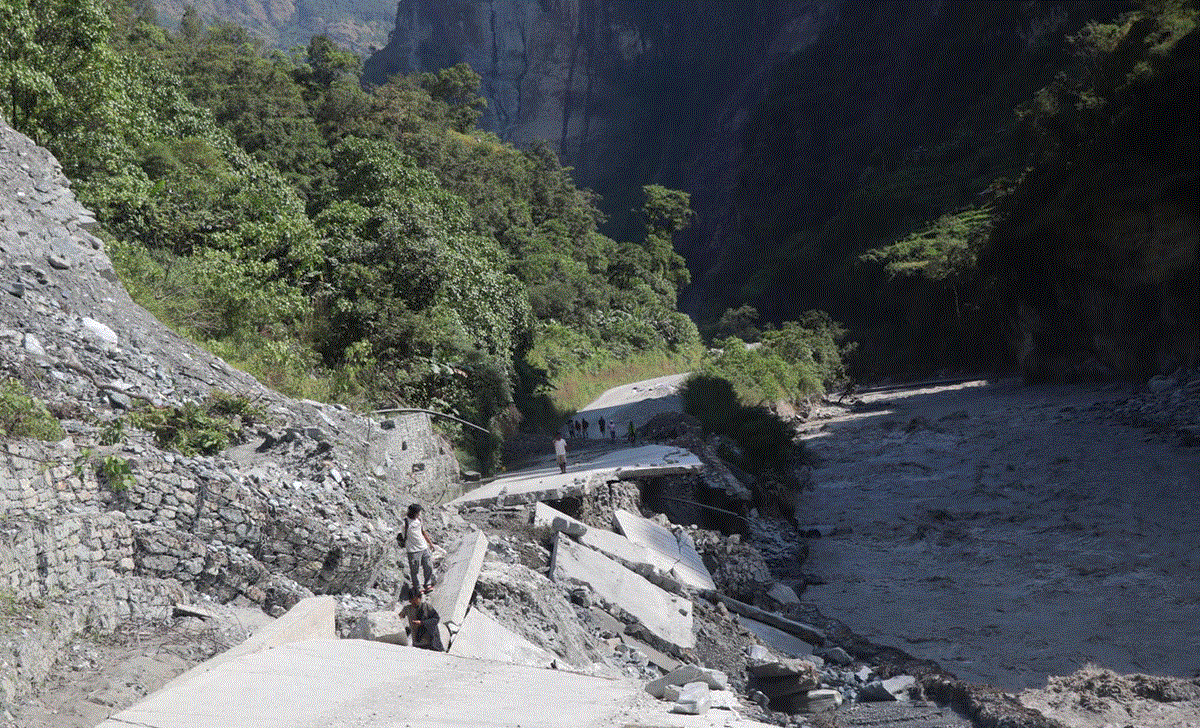
Finance Minister Swarnim Wagle has departed for Washington, DC, leading a Nepali delegation at the invitation of World Bank Group President Ajay Banga. During his visit, Wagle is scheduled to meet senior officials of the World Bank, the US Treasury Department and the International Development Finance Corporation, as well as leading private-sector investors. The meetings are scheduled for October 5 and 6 and will cover bilateral assistance, reconstruction, Nepal’s efforts to exit the Financial Action Task Force grey list and broader economic reforms. The reconstruction and resilient development of infrastructure damaged by the Bhote Koshi flood will also be a major area of discussion with representatives of the World Bank and the US government. The delegation will also explore ways to attract development partners and private-sector investment into economically important infrastructure, including roads and electricity transmission lines. The discussions are expected to focus on mobilising additional support while creating employment and expanding economic opportunities through investment in reconstruction and infrastructure development.
Problematic Cooperatives Return Deposits To 223 More Small Savers
The Problematic Cooperative Management Committee has returned deposits to another 223 savers from four troubled cooperatives, prioritising small depositors. The latest payments cover depositors of Shiv Shikhar, Kantipur, Krishi Bikas and Gorkha cooperatives. The committee has been recovering loans and managing assets belonging to problematic cooperatives and using the recovered funds to return money to affected depositors. Small savers with relatively low deposit amounts have been prioritised in the initial stages of the repayment process. Depositors are being categorised according to the amount of their savings, with repayments being made gradually on that basis. The committee plans to continue prioritising small depositors in subsequent phases before proceeding with payments to other depositors. Loan recovery and asset management are being carried out continuously under the prevailing legal provisions governing problematic cooperatives. Funds recovered through loan collection and asset management are being distributed to depositors as they become available. The committee has made recovery of outstanding loans and management of cooperative assets key components of the ongoing repayment process.
Pokhara Businesses Welcome Resumption Of Regular International Flights
Businesses in Pokhara have welcomed the resumption of regular international flights from Pokhara Regional International Airport, with Flydubai beginning scheduled services after a 45-month wait since the airport opened. The flight service began on September 23, providing passengers from Pokhara with a direct connection to Dubai and onward access to various international cities on a single ticket. The resumption has increased activity in Pokhara, with around 300 foreign tourists arriving through the flight service and contributing to higher business activity and employment opportunities. Tourism businesses have also viewed the service as an opportunity to strengthen the wider economy of Gandaki Province. Hotels, transport operators, shops and small businesses have reported benefits from the increased movement of visitors. Tourism stakeholders have also been preparing plans for tourism entrepreneurs from Pokhara to travel to Dubai in rotation, alongside efforts to attract more visitors to the city. The business community has stressed that the flight should be made sustainable through coordinated efforts so that its economic benefits continue beyond the initial increase in tourist activity.
SEZ Industries Export Goods Worth Rs 4.5 Billion In Seven Years
Industries established in Nepal’s Special Economic Zones exported goods worth Rs 4.5042 billion over seven years, from fiscal year 2019/20 to fiscal year 2025/26. Industries operating in the Bhairahawa Special Economic Zone accounted for the exports during the period, while goods worth Rs 3.1819 billion were consumed in the domestic market. Industries operating in the SEZ have been regularly exporting products, with incentives including income tax concessions, value-added tax exemptions and cash subsidies available for exports. Products exported from the Bhairahawa SEZ include limestone, bulbs, carpets, steel utensils, tanks, plastic products, granite and furnace oil. Most industries established in the zone export their products to neighbouring India. The SEZ programme is intended to promote industrial production and exports by providing infrastructure and fiscal incentives to industries operating within designated economic zones. The export figures cover the seven fiscal years through fiscal year 2025/26 and show that industries operating in the Bhairahawa zone have continued to supply both foreign and domestic markets.
Salt Trading To Import 25,000 Tonnes Of Sugar Ahead Of Major Festivals
Salt Trading Corporation is set to import 25,000 tonnes of sugar from India to prevent shortages in the domestic market ahead of the major festival season. Three railway rakes carrying sugar had already arrived in Birgunj since the beginning of October, bringing a combined 7,990 tonnes and 80 quintals. The first rake delivered 2,679 tonnes and 60 quintals, the second brought 2,671 tonnes and 20 quintals, while the third delivered 2,640 tonnes. The remaining quantity is being prepared for gradual transportation. The sugar was purchased from Renuka Sugar Mill in Gujarat, India, through a government initiative, and the consignment has arrived at the Sirsiya Dry Port in Birgunj. Of the total 25,000 tonnes being imported, Salt Trading Corporation will receive 22,500 tonnes while Food Management and Trading Company will receive 2,500 tonnes. The import has been prioritised because demand for sugar is expected to rise sharply during the upcoming Dashain, Tihar and Chhath festivals, with distribution of the sugar already beginning in the domestic market.
Government Proposes Up To Rs 75,000 Housing Grant Under New Building Bill
The government has proposed providing up to Rs 75,000 in housing grants to poor and vulnerable citizens under a new Building Bill registered at the Federal Parliament Secretariat. The proposal includes Rs 50,000 from the federal government and Rs 25,000 from the provincial government. The Infrastructure Development Ministry has registered the bill to amend the Building Act, 1998, with the objective of ensuring housing for every citizen and their family. The bill proposes guaranteed housing for low-income families and safe and organised housing for middle-income families. Nepali citizens constructing their first homes according to government-approved designs and standards would also be provided essential river-based and natural construction materials free of charge. Similar materials would be available free of charge for livestock shed construction. The bill also proposes relocating disaster-affected, unsafe and vulnerable settlements to safer locations and constructing new houses for affected residents.
Proposed Law Envisages Up to Rs 1.5 Million Fine for Airlines Charging Overapproved Airfares




Comments
0 commentsNo comments yet — be the first.