


Grassroots cadres demand youth leadership under Gagan Thapa while fearing a party split as veteran factions boycott.
Cover caption: Opening ceremony of the Nepali Congress 15th General Convention. Photo: RSS
KATHMANDU: It was around 1:45 PM on Sunday. The energy of the 15th General Convention of the Nepali Congress was gradually building up at Khula Manch. Rallies of cadres, organized into distinct groups from various districts, were entering the venue. A traditional Panche Baja (five musical instrument) ensemble was welcoming them at the grounds. The scorching sun had raised the temperature at Khula Manch, but the sweat-drenched cadres showed no lack of enthusiasm.
They sought youth leadership and the continuation of the leadership elected by the Special General Convention. Simultaneously, there was both hope and anxiety about preserving party unity. Amidst the crowd, Prabhu Nath Yadav, a General Convention delegate from Susta Rural Municipality in Nawalparasi (Bardaghat Susta West), was spotted. Amid the hustle and bustle of the crowd, curiosity was visible on his face, but his stance on the party leadership was clear. “Ordinary Nepali Congress cadres are looking for a new face in the party leadership, and that new leadership is Gagan Thapa,” he says.

Nepali Congress General convention delegate from Nawalparasi (Bardaghat Susta West), Prabhu Nath Yadav. Photo: Khilanath Dhakal
Yadav’s statement was not merely an individual opinion as a Congress delegate; it was an expression of the shared psychology observed at the general convention inauguration venue. “Nepali Congress can no longer run in the old traditional manner,” he was saying. However, alongside the desire for change, there was an equally strong fear within him—that the party might split. “Our desire is for the youth to lead the party, but without the party splitting. Gagan will unite the party,” he says.
His expression seemed to conceal the specific psychology of the 15th General Convention of the Congress. On one hand, there was dissatisfaction with the older generation that had dominated the party for years; on the other hand, there was concern that another split might occur within the party in the name of leadership change. “Cadres wanted a new face in the leadership, but not at the cost of risking the party’s existence and unity. Congress has been winning in all areas of my rural municipality in local elections, and I believe that victory will hold,” he says, hinting at the upcoming local elections.
In this sense, Nepali Congress cadres gathered at Khula Manch from across the country were not limited to formal participation in the General Convention. Along with witnessing the changing psychology of the Congress, they also appeared anxious about its future. Congress cadres were not merely looking to continue a new face in the leadership; they were also trying to change the party’s political culture.

Mayor of Lalitpur Metropolitan City, Chiribabu Maharjan. Photo: Khilanath Dhakal
Mayor of Lalitpur Metropolitan City, Chiribabu Maharjan, appeared equally resolute. According to him, the dispute within the Congress is like a feud between brothers, which will resolve in due course. “I was elected mayor twice in my metropolitan city, and Congress will win again. The party’s general convention is taking place in the process of building such an atmosphere, and it will give direction to the party,” he says. In other words, the current bitterness within the Congress should be understood as a temporary misunderstanding rather than a permanent one. Although incidents surrounding invitations, presence, and absence reveal distance on the surface, politics should not proceed on the basis of splitting or tearing the party apart.
Uddhav Khatri, a General Convention delegate from Kathmandu Metropolitan City–5, held a slightly different view. He states that despite widespread participation in the party’s general convention, it would be unfair to blame the current leadership for the exclusion of a particular group. “Why did you leave? Why did you step aside? Didn’t you go to contest the House of Representatives under Gagan Thapa’s signature?” he questions. “If you had been able to unite happily, show love, and express cordiality, Sher Bahadur Deuba would have become the widely accepted leader.”

General Convention delegate from Kathmandu Metropolitan City–5, Uddhav Khatri. Photo: Khilanath Dhakal
Gagan on the legitimate path of the Special Convention
The inauguration time for the 15th General Convention was scheduled for 2:00 PM. As that time passed, the eyes of the cadres packed in the field were waiting for the leaders on the stage. However, the program started only at 2:45 PM. When President Thapa stepped onto the stage, the crowd cheered loudly.
General Secretary Pradeep Paudel began conducting the program. Suddenly, it started to rain. The crowd began moving inside the halls prepared for the convention to shelter from the rain, while some took cover under umbrellas. Under these circumstances, Paudel initiated the program. Thapa assumed the chair. He did not invite anyone as the chief guest.
The Congress led by Thapa had extended an invitation to outgoing President Deuba as the main guest. However, the representation from the Deuba–Koirala faction—including President Deuba (elected from the 14th General Convention), Vice President Purna Bahadur Khadka, defeated presidential candidate Shekhar Koirala, former Vice President Bimalendra Nidhi, former General Secretary Shashank Koirala, and Prakash Man Singh—was virtually zero. Paudel did not seat any leader elected from the 14th General Convention from the Deuba–Koirala faction on the dais.

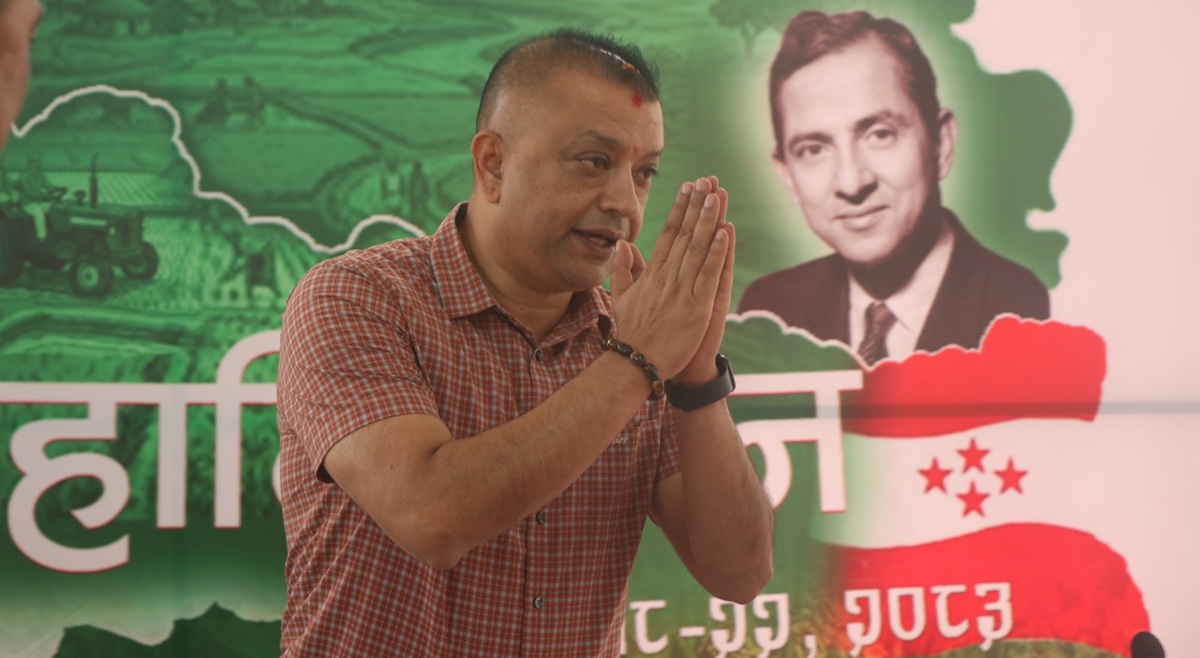
Nepali Congress President Gagan Thapa delivering his speech at the inauguration ceremony of the party’s General Convention. Photo: RSS
As the rain stopped and conditions normalized, Poudel had already seated leaders from other invited parties as guests. Although no names from the Deuba–Koirala group were uttered, only a limited number of leaders, including Balkrishna Khand, Min Bishwakarma, Dhanraj Gurung, Chandra Bhandari, and Ramhari Khatiwada, were seated on the stage.
Despite the absence on stage of leaders elected from the 14th General Convention, President Thapa, who was elected from the Special General Convention on January 11, 2026, was making a final effort to maintain the legitimacy of his ‘interim’ Congress. According to the Congress statute, there is a provision that a regular general convention must be held within one year of holding a special general convention. Due to this provision, Thapa faced the challenge of conducting the regular general convention. On that benchmark of legitimacy, Thapa has proven himself capable. Thapa has managed to establish the strength of the Special General Convention under his own leadership. Official recognition of the Congress rests with Thapa. However, the dispute regarding the official status of the Congress remains pending before the Supreme Court.



Comments
0 commentsNo comments yet — be the first.