
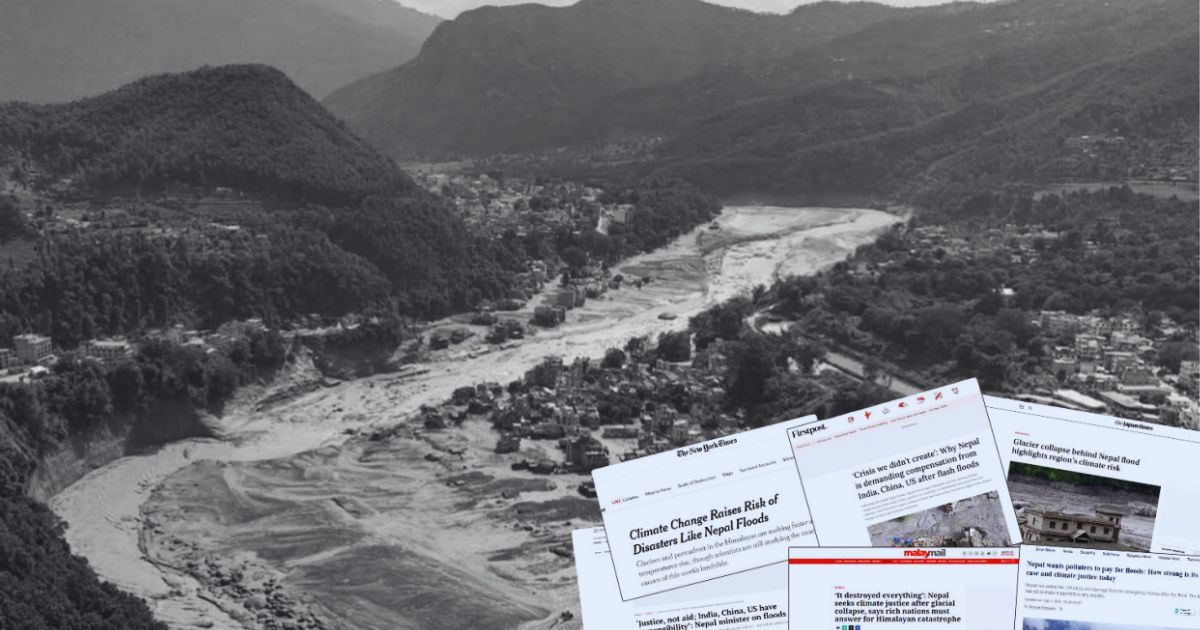
Nepal has formally lodged a claim with the United Nations Fund for Responding to Loss and Damage, demanding financial redress for billions of dollars in destruction unleashed by recent catastrophic floods in the northern district of Rasuwa.
The formal submission on 4 September 2026 (19 Bhadra 2083) marks a pronounced shift in Kathmandu’s diplomatic posture, pivoting from appeals for humanitarian assistance toward an explicit demand for legal and moral reparations from the world’s primary greenhouse gas polluters.
According to World Bank data, Nepal emits just 0.54 metric tons of carbon dioxide per capita annually, a negligible fraction of the global average of 4.67 tons, and far below the 13.6 tons per capita produced by the United States or China’s 9.3 tons. Despite contributing almost nothing to global atmospheric warming, the Himalayan nation faces acute, disproportionate consequences as its glacial infrastructure destabilizes.
Foreign Minister Shishir Khanal emphasized the policy shift, stating that climate diplomacy must transition from seeking voluntary aid to securing formal restitution. This is not a matter of charity, Khanal noted, but an issue of legal and moral responsibility. The position has been reinforced by head of government statements insisting that the international community, having generated the emissions driving these crises, bears an inescapable obligation to finance mitigation and recovery in frontline states.
Mechanics of Collapse
The devastation in Rasuwa has attracted intense scrutiny from earth scientists analyzing the convergence of factors behind the catastrophe. Satellite assessments indicate that the disaster began as a massive displacement of snow, weakened rock, and degraded permafrost on the upper slopes within Nepal before breaching borders and cascading down river valleys on both sides of the frontier.






Comments
0 commentsNo comments yet — be the first.