


Amid unresolved legal disputes and deep intra-party rifts following the Gen Z uprising, the Nepali Congress faces its sharpest factional split since 2002.
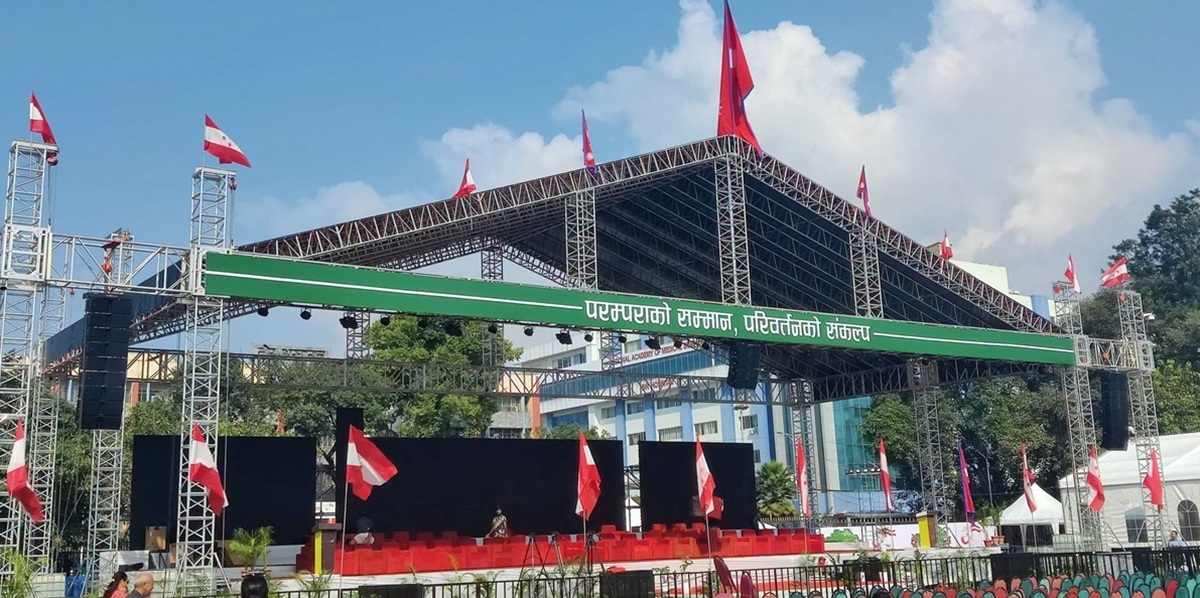
KATHMANDU: The Nepali Congress under President Gagan Thapa, propelled to power through the Special General Convention in January, steps onto the stage of its 15th General Convention starting today (Sunday). The only difference is that the venue for the opening ceremony has shifted from Bhrikutimandap to Khulamanch. The reason participation appears as restricted as a special convention is that while the Thapa-led Nepali Congress is holding its convention, the group of outgoing President Sher Bahadur Deuba is conducting a separate general convention. Leaders and cadres have been divided between the two sides.
The convention of the Thapa-led Nepali Congress is set to run for four days. Meanwhile, the Deuba faction is organizing its 15th General Convention from December 7–9, 2026. In preparation for that, the Deuba group has been holding ward conventions across 6,743 wards since October 1. According to leader Prakash Sharan Mahat, ward conventions have already been completed in more than 3,000 wards, while the remaining wards are in the process of completion.
The Thapa-led leadership has proven unsuccessful in gathering both factions in one place to hold a joint general convention. Nine months after the conclusion of the special general convention, the Nepali Congress—a political party carrying the oldest and longest history in the democratic movement—stands on the precipice of a formal split. Without resolving the legitimacy dispute pending before the Supreme Court and without seeking an internal political solution, the Thapa-led Nepali Congress is unilaterally proceeding with its general convention.

Logo of the 15th General Convention of the Nepali Congress.
The statistics on how many convention delegates are participating in the convention of the Thapa-led Congress, which convened a special general convention on January 11, 2026, remain uncertain. Holding a press conference on Friday, the Nepali Congress stated that all preparations to complete the general convention had been finalized, but it was unable to disclose the exact number of convention delegates. The inability of the Thapa-led Nepali Congress to specify delegate numbers stems from the split of leaders and cadres into two distinct camps.
According to the Central Election Committee, the closed-door session is scheduled for October 5–6, while the election process will begin on October 7 and 8.
According to Acting Chief Secretary Krishna Prasad Dulal, the total number of general convention delegates is 7,900. How many of them will attend cannot be determined at present. “The arrival and registration of convention delegates have already begun. The exact figure can only be stated once the closed session begins after the inauguration,” he says. “Since delegates are coming even from remote hill regions, their arrival will continue right up to the closed session.”
According to Mahat, leaders and cadres who stand by the ideals and integrity of the Nepali Congress and are free from greed have gathered at their own expense to preserve the party’s principles and values. Dissident leaders and cadres in the Thapa faction have returned to the December convention fold. “The ward conventions will conclude within two to three days. Due to technical reasons, ward conventions had to be conducted in remote areas within a short frame. It was slightly delayed due to time pressure,” he says. “We are holding the 15th General Convention with the maximum participation of leaders and cadres.”

Sher Bahadur Deuba and Gagan Kumar Thapa. File photo: Nepal Photo Library
Spokesperson Devraj Chalise states that the Thapa faction has invited various political parties to the opening ceremony of the convention. Attendees include Rastriya Swatantra Party Chairman Rabi Lamichhane, Communist Party of Nepal (UML) Chairman KP Sharma Oli, Nepali Communist Party Chairman Pushpa Kamal Dahal ‘Prachanda,’ Rastriya Prajatantra Party Chairman Rajendra Lingden, Janata Samajbadi Party Chairman Upendra Yadav, Janamat Party Chairman Chandra Kant Raut, Shram Sanskriti Party General Secretary Aaren Rai, and Acting General Secretary Ghanshyam Paudel representing the Rastriya Janamorcha Chairman.
According to the Central Election Committee, the closed session will take place on October 5–6 and the election process will be conducted on October 7 and 8. The Nepali Congress is preparing to conduct the election through consensus wherever possible. Thapa stands as the sole, unopposed candidate for presidency at the convention. The nomination of candidates for the election of the Central Working Committee under the general convention will take place at the Rashtriya Sabha Griha on October 5 from 2:00 PM to 6:00 PM.
The then General Secretaries Gagan Kumar Thapa and Bishwa Prakash Sharma had called the special general convention with the signatures of 54 percent of the general convention delegates.
The special general convention dissolved the Central Working Committee elected under Deuba’s leadership during the 14th General Convention. On January 16, the Election Commission granted legitimacy to the Thapa-led faction. Following this, the legitimacy dispute of the Nepali Congress reached the Supreme Court. On April 17, the Supreme Court recognized the Thapa leadership. However, the court granted a review permit on August 7, stating that it would review the Nepali Congress legitimacy dispute from the beginning. While that legitimacy dispute remains pending in court, the Thapa leadership has forged ahead with the convention. “Negotiations and dialogue are no longer necessary; the party has already entered the general convention, and all party leaders and cadres are eligible to participate,” says Spokesperson Chalise.
That split and this split in Nepali Congress
The then General Secretaries Gagan Kumar Thapa and Bishwa Prakash Sharma had called the special general convention with the signatures of 54 percent of the general convention delegates. Following the Gen Z movement, they ran a signature campaign questioning the justification of the existing leadership. It was on the strength of those signatures that the special convention took place, drawing the battle lines of a split within the Congress. While the special general convention was expected to offer an opportunity for reform, it is instead turning into a historic split.

Nepali Congress Vice President Bishwa Prakash Sharma, President Gagan Thapa, and others. File Photo
The split visible in the Nepali Congress today mirrors the sequence of events from 2002. At that time, Deuba himself was the catalyst behind the party split. In the current split, Thapa plays the decisive role. Thapa has not demonstrated the political maturity or capacity to bring the faction that abstained from the special general convention into the 15th General Convention. Deuba-faction leader NP Saud remarks, “The case is pending in court, and now the court will be the final arbiter. Since you are holding the general convention while the case is sub-judice, it is impossible for the other side not to make its own preparations.” According to him, the possibility of unity has faded as no concrete negotiations or dialogues could take place.





Comments
0 commentsNo comments yet — be the first.