

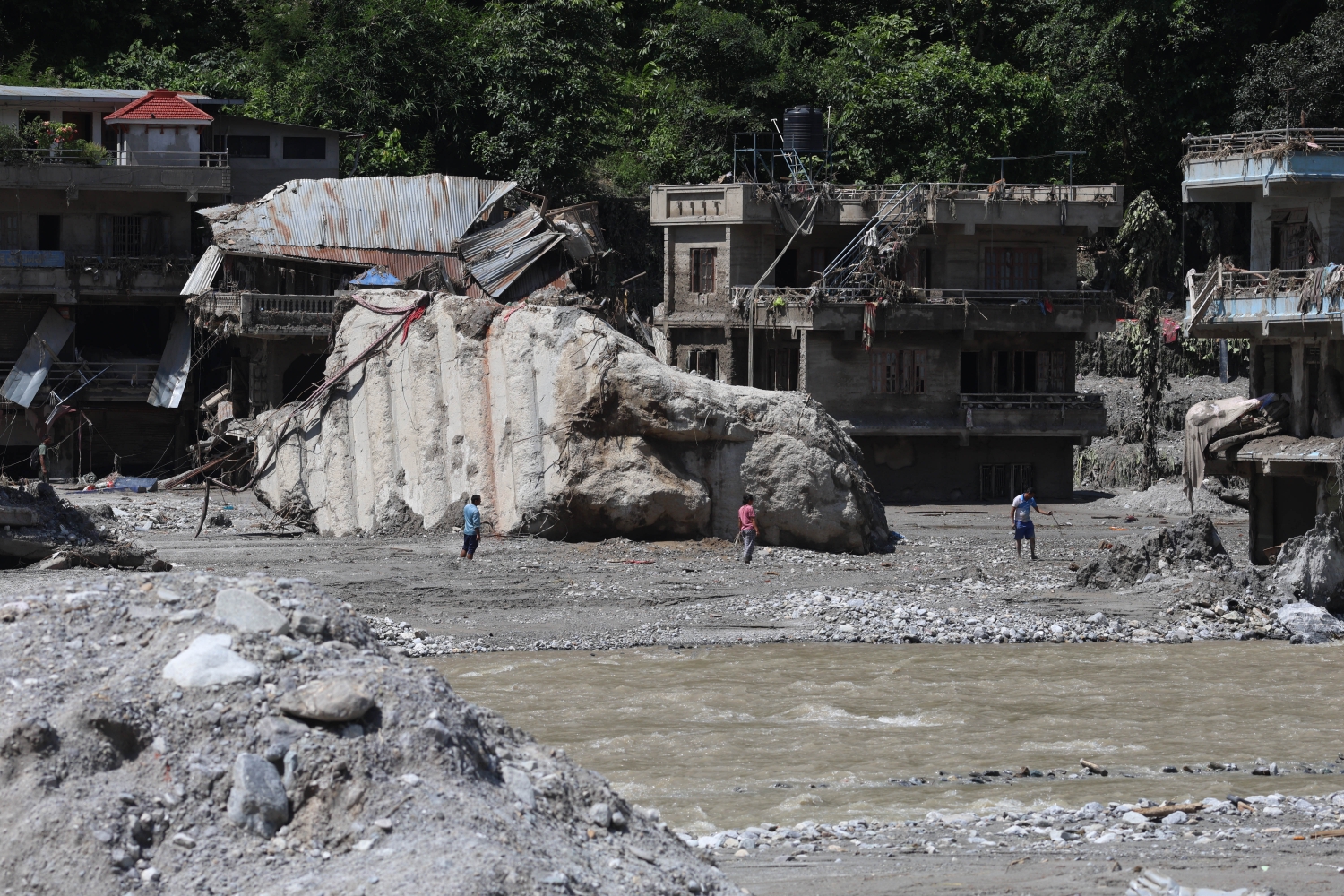
The Bhote Kosi-Trisuli disaster was not a ‘Himalayan tsunami’. It was a mountain collapse.
That may sound like a bureaucratic distinction but it is not. It is the difference between understanding what happened and getting the next response to it seriously wrong.
A tsunami is created when a large body of water is suddenly displaced, most often in the sea by an earthquake, volcanic eruption or an ocean landslide. The words itself come from a Japanese word, Tsu meaning harbour’ and nami, meaning wave.
Rasuwa had neither a harbour nor an ocean wave. It began somewhere else entirely, on a ruggedly high Himalayan slope and not under the sea. A vast mass of bedrock and glacier ice broke away, crashed into the valley below a set off a destructive flood that travelled through the river system.
Bodies are still being pulled from the river corridor and wreckage downstream. Families are still waiting for news of people who disappeared. That is why this cannot be reduced to a captivating, but false label.
The flood was real. The devastation was real. But the label is wrong. Calling it a ‘Himalayan tsunami’ may make for a powerful headline, but it crushes a complex mountain disaster into a misleading metaphor. It suggests that a great wave simply came down the valley. It did not. A mountain failed. Ice, rock, sediment and water moved together in a violent chain of events that began far above the riverbanks and ended in destruction downstream.
The evidence points to a major slope failure involving bedrock and glacier ice on the north face of Langtang Lirung. The mass fell around 1,200 meters into the Lhende Khola valley, broke apart into rock, ice and meltwater, and became a fast-moving debris flow. One estimate puts its leading edge covered the first 22 km at about 190 km/h, although scientists have cautioned that the speed estimate are still being reconciled.
The avalanche and debris flow appear to have obstructed the river. Water and debris built up behind the unstable blockage. When the blockage gave way, a violent surge of water, mud, rocks and sediment tore down the Bhote Kosi and Trisuli systems. It was an ice-rock avalanche that became a lethal debris flow and flood, not a tsunami.
There was no conventional glacial lake bursting. This was not a routine monsoon flood. Nor was it an ocean disaster transplanted into the Himalaya. It was a cascading mountain failure: slope collapse, ice-rock avalanche, river blockage, dam breach and flood.






Comments
0 commentsNo comments yet — be the first.